What is AI Visibility and Why It Matters
AI search visibility is how often, how clearly, and how well your brand shows up in AI answers. Those answers come from tools like ChatGPT, Perplexity, and Google AI Overviews. It matters because people now get answers straight from AI. Usually they never click a link.
Not long ago, a search ended with a list of links. Now it often ends with a single answer — and that answer names a few brands and leaves the rest out. AI search visibility is about being one of the brands that gets named. This guide explains what it means, why it matters, and how to measure and improve it.
Key takeaways
AI search visibility is whether your brand appears inside AI answers. It is not about where you rank in a list.
It matters because buyers now build their shortlist inside AI answers. They often do not click. And the model shapes how you are seen.
AI systems favour sources that are clear, original, well structured, trusted, and current. These match the E-E-A-T framework.
To improve, write answer-first, share original data, structure your content, build linked clusters, earn outside trust, and stay current.
Measure it by asking the same prompts across engines over time. Treat the score as a guide, not an absolute.
What is AI search visibility?
AI search visibility is how much your brand shows up inside AI answers. You ask an AI tool a question. It writes back an answer. That answer often names real products, companies, or sources. Whether it names you, and how it describes you, is your AI search visibility.
Here is a simple example. Ask Perplexity for the best headphones under $200. It will name three to five models. Each one gets a short reason. Every brand it names is visible. Every brand it skips is invisible for that question. Those brands are not ranked lower. They are just gone.
A few terms get mixed up, so it helps to keep them apart:
AI visibility — being named and recommended across AI tools.
AI searchability — how easily AI can find and reuse your content.
Generative Engine Optimization (GEO) — the work of getting your content named in AI answers. It is the AI version of SEO.
The main idea is simple. Being visible in AI search means the models trust your content enough to use it.
How is AI search visibility different from SEO visibility?
SEO visibility is about where you rank in a list. AI search visibility is about whether you appear inside one answer. For years, being visible meant ranking high on a page of links. People scanned the page and clicked. AI search works differently. Often there is no list to rank in at all.
Here is why. A normal search engine finds pages and sorts them. Then it shows you the links. An AI engine finds sources, reads them, and writes one answer. As it writes, it picks which sources to name. Google's AI Mode is the clearest case. It launched in May 2025. It shows no blue links. So being named in the answer is the only way to be seen.
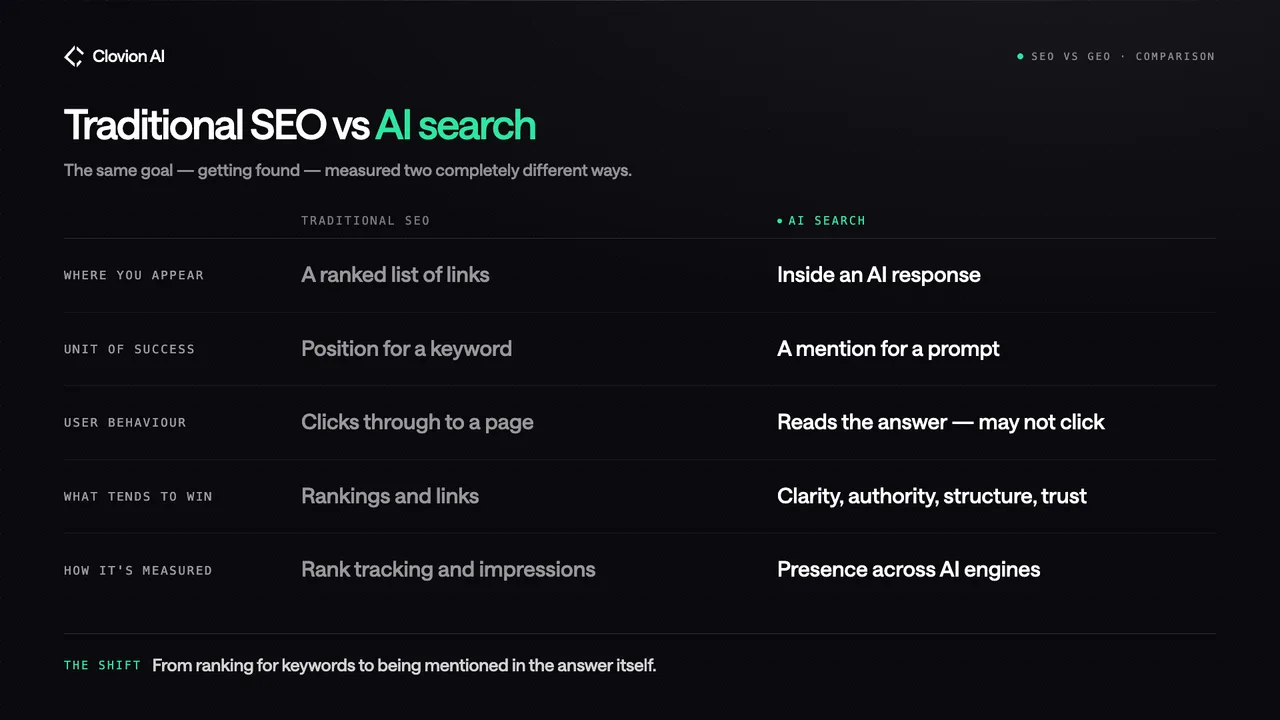
The two are linked. Good, clear content still helps in both. But they are not the same job. Ranking on a page and getting named in an answer need different tactics.
What does an AI visibility score measure?
An AI visibility score is one number. It shows how present your brand is across AI answers. Reading every answer by hand does not scale. So people turn the picture into one score. There is no single agreed formula. But most scores use four inputs.
Mention frequency. How often you appear across a set of prompts. Named in eight of ten answers beats named in one.
Prominence. Where you appear in the answer. Named first is stronger than named last.
Sentiment. How the model describes you. “The most reliable option” and “a cheap pick with mixed reviews” are both mentions. They feel very different.
Share of voice. How you compare with rivals on the same prompts.
A USEFUL CAUTION
A score is only as good as its prompts. Pick ten easy prompts and you will look great. Pick the questions real buyers ask and the score may drop. Treat the number as a guide to track over time. Do not treat it as the full truth.
Why does AI search visibility matter?
It matters because buyers now build their shortlist inside an AI answer. This happens before they reach a website. If the model does not name you, you are not in the running. And you may never notice. There was no click to track. Three shifts explain the change.
The click is now optional — AI answers solve many questions on the spot. A recommendation inside the answer can shape a choice with no visit to your site.
The answer names fewer brands — Ten links gave many brands a chance. One AI answer names two or three. Being left out costs more than a low rank.
Perception is at stake, not just presence — AI decides how it describes you, not just whether it names you. A clear, correct description and a wrong one both shape what buyers think.
This is why many teams now treat AI visibility as a brand issue. In an answer-first world, what the models say about you becomes what the market believes.
The scale of the shift is measurable. A 2026 Semrush study of 126 million AI search prompts found that brands are now mentioned, cited, and summarised across many sources at once, not ranked in a single list. It also found a clear split: 81% of teams that combined their SEO and AI work reported more traffic or leads from AI, while only 36% of those who kept the two separate did.
So the saying "Traditional SEO is dead' is not completely true. It is true, it's not enough to work alone anymore but it is still the foundation that GEO layers on.
How do AI systems decide which brands to mention?
AI systems tend to name sources that are clear, trusted, well organised, current, and easy to credit. No single thing promises a mention. But these factors set the named sources apart.
They also match Google's E-E-A-T framework: Experience, Expertise, Authoritativeness, and Trustworthiness. Google itself calls trust the most important of the four.
Clarity and quotability
Models reuse clean, standalone lines more easily than buried ones. So lead with a direct answer. A clear definition, a number, or a simple step is easy to lift and credit.
Original, first-hand information
Your own data, research, and case studies get cited more. The reason is simple. No one else has them. A test you ran gives the model something unique to point to.
Structure and machine-readability
Clear headings, tables, lists, and schema help AI read and credit your content. Neat formatting over thin content fools no one. But real substance in a clean layout is the goal.
Topical authority
Models prefer sources that go deep on a topic. A set of linked pages beats one lonely post. Depth signals expertise.
Off-site trust and entity clarity
Mentions and reviews from trusted third parties tell the model who is credible. Use your name the same way everywhere. This helps the model match the right facts to you.
Freshness
For fast-moving topics, being current is its own signal. Show publish and update dates. Keep the content up to date. Fresh sources get cited ahead of stale ones.
WHAT RESEARCH SHOWS
Specificity is what keeps you in the answer. A 2026 Clovion study of 69,120 AI conversations tested what happens when a buyer adds a detail to a follow-up question. Simply re-asking the same question kept about 90% of the recommended products. Adding one ordinary detail, such as “for a small team,” kept only 28%. Roughly two in three products dropped out.
How can you improve your visibility in AI search?
You improve AI visibility by being the clearest, most trusted source on your topic. Then you check that your changes work. Here are the main steps.
Write answer-first. Start each page with a direct answer. Then add detail. Definitions, steps, and comparisons work best.
Publish original data. Share your own stats, research, and case studies. Unique data is one of the strongest ways to get cited.
Structure for extraction. Use clear headings, tables, lists, and schema. This helps AI read and credit your work.
Build clusters, not orphans. Group related pages and link them. Broad coverage signals authority. Lone pages rarely get cited.
Earn off-site trust. Get mentions and reviews from trusted sources. Your site cannot be the only place you look good.
Keep it current. Add clear dates. Refresh old claims. Stale content gets pushed down.
Measure before and after. Track your visibility before and after each change. That is how you learn what works.
How do you track and measure AI search visibility?
You track it by asking the same prompts across several AI tools on a schedule. Then you record how your brand shows up and watch the trend. A simple process has four steps.
Pick a real prompt set. Use the questions your audience actually asks. Not just the ones you want to win.
Ask several engines. ChatGPT, Perplexity, Google AI Overviews, Google AI Mode, and Bing Copilot can answer the same prompt in different ways.
Record how you appear. Note if you show up, where, how you are described, and who appears with you.
Watch the trend. One snapshot is noise. The direction over time is what counts.
You can do this by hand for a few prompts. It gets hard fast and keeping track over time manually isn’t as easy as it sounds.
There are AI visibility tools now that do the asking, scoring, and benchmarking for you. So you can focus on your improvements and content.
What to look for in an AI visibility tracking approach or tool.
Capability | Why it matters |
|---|---|
Multi-engine coverage | Visibility differs by platform. One engine misleads you. |
A clear, steady score | A single number is what makes progress easy to report. |
Sentiment analysis | Shows how you are framed, not just whether you appear. |
Competitor share of voice | Context for your score. Are you gaining or losing ground? |
Prompt-level detail | Knowing which prompts you win or miss is where work starts. |
The platform-by-platform point is not a guess. In the same Semrush 2026 index, ChatGPT cited about 15 sources per answer while Gemini cited about 3. On Gemini, the brands mentioned and the domains actually cited overlapped by as little as 30%.
So a brand can look strong on one engine and be nearly absent on another. Measuring is hard, too. Many marketing leaders cannot still do not accurately measure their AI visibility, and only few keep track of every metric across platforms.
If you want buyers to know who you are, then review AI visibility next to rankings, traffic, and pipeline. Do not treat it as a one-off audit. A sudden drop often points to a rival's new content, a factual error the models picked up, or a stale topic. Each one is worth acting on.
Final thoughts
AI search visibility is not a passing trend. It is the new place where buyers form a first impression of your brand. That impression is written by a model, not chosen from a list of links.
You do not need to chase every engine at first or try to trick the system.
Start small. Pick a short prompt set. Track how you show up across a few engines. Improve one thing at a time. The brands that build this habit now will be the ones AI keeps recommending as the tools, and the buyers, keep changing.
Frequently Asked Questions
Reading is fine. Measuring is better.
Free score in 60 seconds. Enter your domain and see how the major AI engines mention you, which competitors appear, and where to improve.