The Conversation Problem: Why One Sentence Rewrites What AI Recommends
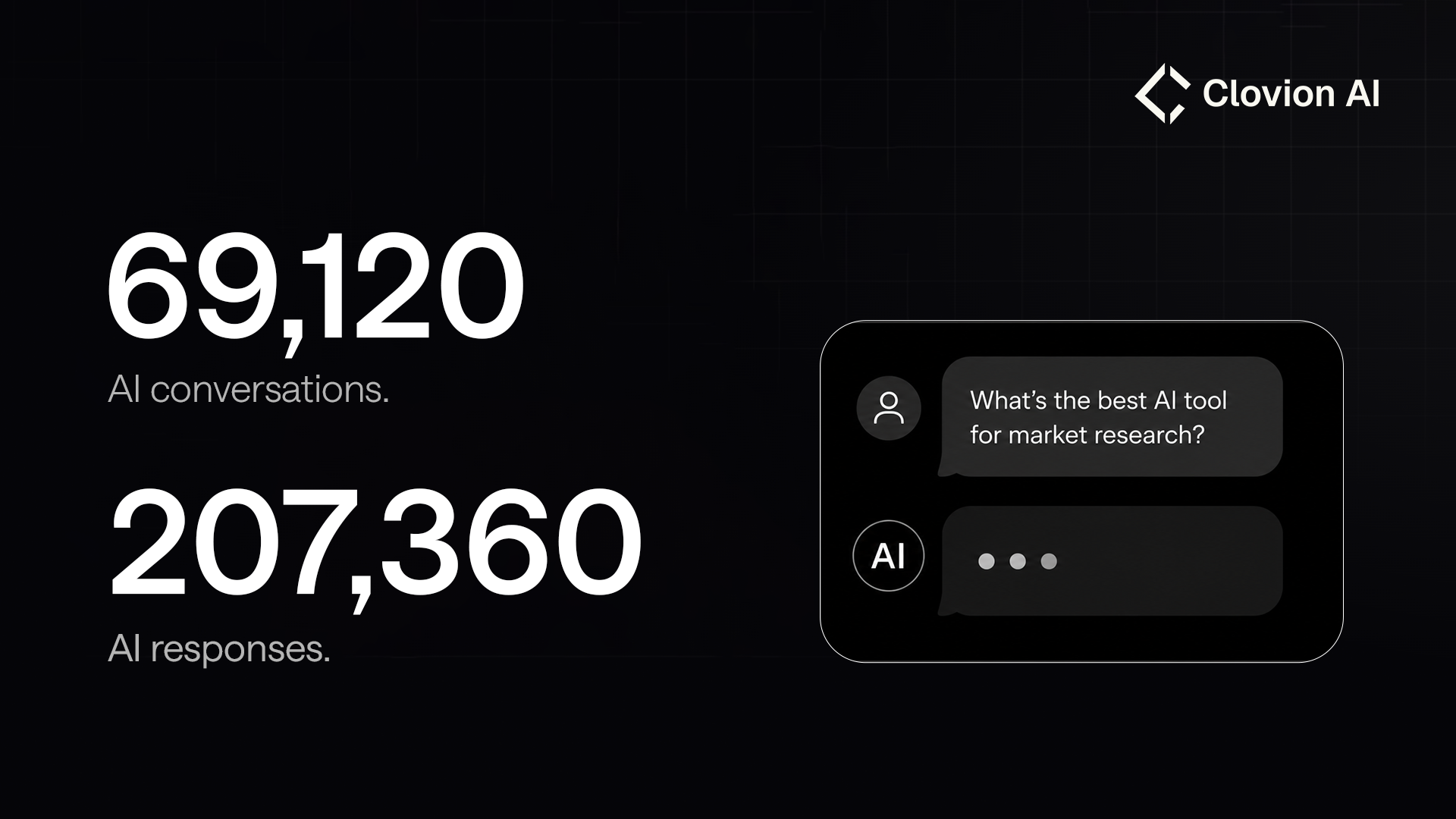
We studied 69,120 AI conversations. One extra detail from a buyer replaces ~64% of recommended products. Here's what it means for AI search visibility.
Buyers don't ask an AI one question and walk away. They ask, then add a detail, then narrow down. We wanted to know what that does to the products an AI recommends — so we read 69,120 real conversations across ChatGPT, Claude, and Gemini. The answer reshapes how brand visibility in AI should be measured.
Key Takeaways
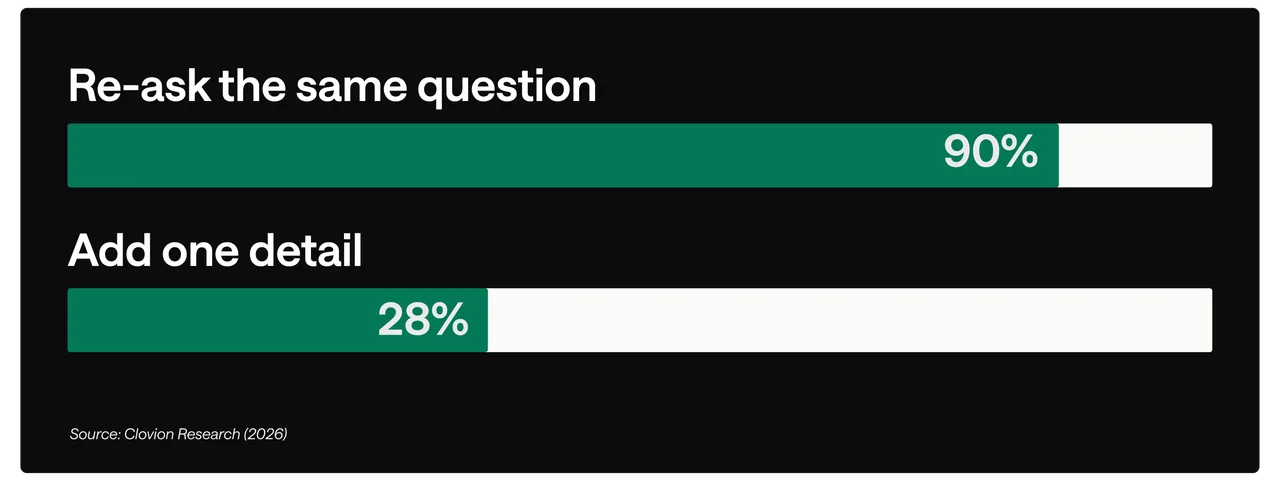
Re-asking the same question keeps 90% of the recommended list. Adding one ordinary detail keeps just 28% — about 2 in 3 products vanish.
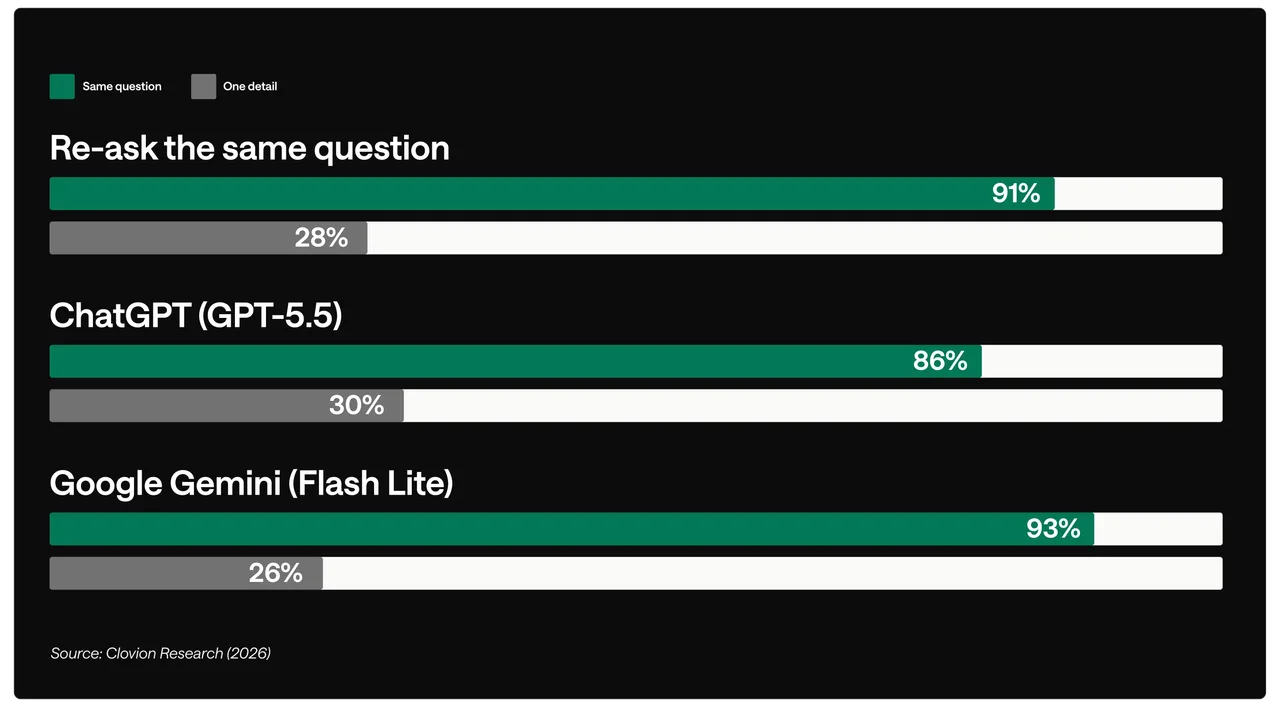
The collapse happens on every engine: Claude 91%→28%, ChatGPT 86%→30%, Gemini 93%→26%.
First-answer rank predicts survival best (top-3: 62% vs. rank 7+: 36%), but even top-3 products drop 38% of the time.
Generically described products are cut first; products tied to concrete fit (segment, price, integrations) survive.
What did the study actually measure?
We tracked “list match”: how much of a recommended list survives from one answer to the next (100% means nothing changed). We asked each AI for the best tools in a category, then gave it one of four follow-ups.
One simply re-asked the same question as a baseline; the others added a single detail like “for a small team.” Every follow-up requested a similar-length list, so the metric captures which products changed, not how many.
How much does one detail really change?
Re-asking the same question keeps 90% of the list. Adding a single detail keeps only 28% — roughly 64% of the recommended products disappear. The stability of the re-ask (90%) shows the AI isn't being random; the list collapses specifically because the buyer added information, which is exactly what real buyers do.
And almost any detail does it: "small team / budget" drops list match to 28% and "enterprise" to 27%, while even asking the AI to pick one option pulls it to 39% — each detail dropping four to five products and adding about four.
Does this happen on every AI, or just one?
It happens on every major engine. All three engines stay steady on a repeat (86–93%) and change heavily on one detail (26–30%). Claude moved 91%→28%, ChatGPT (GPT-5.5) 86%→30%, and Gemini 93%→26%.
Gemini reshuffles hardest and ChatGPT the least — which is why tracking a single engine misstates your real exposure.
Which products survive the follow-up?
First-answer rank is the strongest predictor. Top-3 products survive a follow-up 62% of the time, ranks 4–6 survive 47%, and rank 7+ survives just 36%. A strong start is a real edge but not a guarantee — top-3 products still drop 38% of the time.
Two factors matter less than expected: well-known brands held on only slightly better (63% vs. 56%), and company age made no reliable difference (under 8 years: 63%; over 15 years: 57%). Older is not safer.
Why do some products get dropped and others appear?
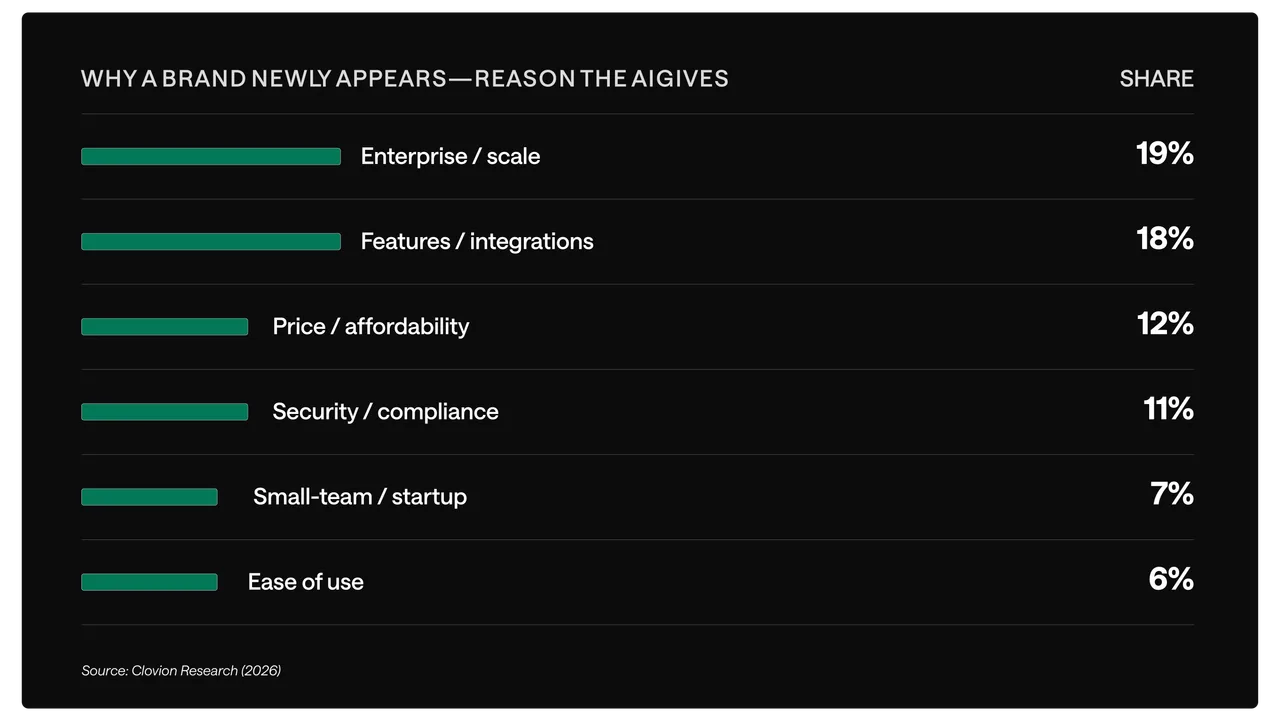
Specific fit wins; generic gets cut. Products that newly appeared were named for concrete reasons — enterprise/scale fit (19%), features and integrations (18%), and price (12%), per the AI's own stated reasons.
The dropped products are the inverse: 27% had been described only in broad terms like “a popular choice.” A product an AI can describe only generically is the first one cut when a buyer gets specific. (These are patterns in how the AI explains its picks, not a verified look inside the model.)
What should marketers actually do about it?
Win the conversation, not just the first answer.
Track recommendations across the full conversation, per engine. A single “are we mentioned?” check only measures the stable 90% baseline, not real buyer behavior.
Tie your product to specific needs in public content — segment, price tier, security, integrations. Fit is what new entrants won on; generic descriptions got dropped.
Fight for a top-3 first-answer position, but don't rely on it alone (top-3 still drops 38% of the time).
Watch all three major engines. Change ranges from 56% on ChatGPT to 68% on Gemini.
You can't edit an AI directly. You can shape the public information it draws on — and watch how you're represented as the conversation, the engine, and the context shift.
Reading is fine. Measuring is better.
Free score in 60 seconds. Enter your domain and see how the major AI engines mention you, which competitors appear, and where to improve.