Is Traditional SEO Dead? How AI Search Is Changing Everything.
Traditional SEO isn’t dead, but AI search is changing how brands are discovered. This blog explains how SEO, AEO, and GEO work together to help brands rank, get cited, and show up inside AI-generated answers across tools like ChatGPT, Perplexity, and Google AI Overviews.
No, traditional SEO isn't dead. But if it's the only thing your team is doing, you’re only addressing part of the picture.
Here's what changed. When someone types "best CRM for startups" today, they don't always get ten blue links. Instead, they see an AI-generated answer: a synthesized recommendation with brand names, feature comparisons, and source citations built right in. That answer appears in Google's AI Overviews (now live in over 200 countries), in ChatGPT, in Perplexity, and across a growing list of AI platforms worldwide.
Your brand either gets named in that answer, or a competitor does. You might never know it happened.
This isn't the death of SEO. It's the arrival of a new discipline on top of it: Generative Engine Optimization (GEO). This post covers what the data actually shows, why it matters for brands globally, and what to do about it.
Key Takeaways
Traditional SEO isn't dead, but it's no longer enough on its own. AI-generated answers are absorbing the clicks that used to flow to organic results.
The new goal is getting recommended inside AI responses, not just ranking below them. Brands that earn citations see more traffic, not less.
Start with three moves: unblock AI crawlers, monitor your visibility across AI engines, and restructure key pages so large language models can extract and quote them.
Nearly 70% of businesses that invest in AI-focused SEO report higher ROI than traditional SEO alone (Semrush, 2026).
How Fast Is AI Search Growing Globally?
ChatGPT reached 900 million weekly active users by February 2026, more than doubling its base from the prior year (TechCrunch, 2026). Google's AI Overviews now operate in over 200 countries and 40 languages, and AI Mode has crossed 100 million monthly active users (Google, 2026). Perplexity processes more than 780 million queries per month. This is no longer an experiment limited to the U.S.
Think about how search used to work. You'd type a query, skim a list of links, open a few pages, compare what you found, and form your own answer. That process took multiple tabs and several minutes.
Now, the entire journey collapses into one step. You ask a question. The AI gives you a synthesized response drawn from multiple sources, with brand names, comparisons, and recommendations baked in.
AI-generated answers are changing the search experience.
More users now get what they need directly from the response, without clicking through to a website. They ask a question, scan the AI response, and move on. They got what they needed.
So where does that leave the pages you spent months optimizing?
It does not make them useless. But it does change their role.
Your pages are no longer just competing for clicks. They are also becoming source material for AI systems. The content you publish helps AI tools understand your brand, explain your expertise, compare you with competitors, and decide whether to mention you in the first place.
That means SEO is not only about ranking anymore.
It is about becoming clear, credible, and structured enough to be part of the answer.
Does Ranking #1 on Google Still Pay Off?
Less than it used to, especially for informational queries.
Ahrefs analyzed 300,000 keywords and found that position-one CTR dropped by 58% on queries where an AI Overview appeared, comparing December 2023 to December 2025 (Ahrefs, 2026). That study used aggregated Search Console data and controlled for general SERP trends, making it one of the most rigorous measurements available. The effect is getting worse over time: the same methodology showed only a 34.5% drop eight months earlier.
For the "what is..." and "how to..." queries that drive most top-of-funnel traffic, the AI now answers the question before anyone reaches your page.
But ranking still holds real value for commercial-intent keywords. When someone searches with purchase intent ("pricing," "buy," "compare plans"), traditional rankings still drive clicks. Most marketers globally say the #1 position matters for these kinds of queries.
Why Does Traffic from AI Platforms Convert So Much Better?
Because of intent. When an AI tool names your product in a synthesized answer, the person clicking through has already been pre-qualified. The AI answer has already helped them understand the options, so by the time they click, they usually have a clearer idea of what they are looking for.
Think about the difference in mindset. A traditional Google searcher is still in discovery mode. They're scanning links, comparing options, and opening tabs. An AI search user asked a direct question and got a direct answer that mentioned your brand by name. By the time they click, half the decision is already made.
AI-referred visitors converted at 5.97%, compared to 0.72% for traditional traffic, showing that AI referrals may bring lower volume but much stronger intent (NP Digital, 2025).
That's why conversion rates from AI referrals consistently outperform traditional organic across every platform measured. ChatGPT drives the largest share of AI referral traffic today, but Perplexity and Claude are gaining ground fast, particularly with B2B and research-heavy audiences.
The volume is still small compared to organic search for most brands. But it's growing rapidly, and the quality of those visits is significantly higher.
What Is GEO, and How Does It Differ from Traditional SEO?
Generative Engine Optimization (GEO) is the practice of making your content citable by AI. You might also see it called Answer Engine Optimization (AEO) or LLM Optimization (LLMO). Same goal, different labels.
The core distinction is simple. Traditional SEO asks: how do I rank higher in a list of links? GEO asks: how do I become a source that AI tools pull from when they compose an answer?
These are genuinely different problems. A page can rank #1 on Google yet never appears in a ChatGPT response, because it lacks the structural signals language models look for. The reverse is also true: a well-structured page on page two can absolutely earn citations from Perplexity or Claude if it provides clear, sourced answers to specific questions.
The good news is that these disciplines don't conflict. They compound. Brands named inside AI Overviews see better traditional click-through performance, not worse. GEO amplifies what SEO already does.
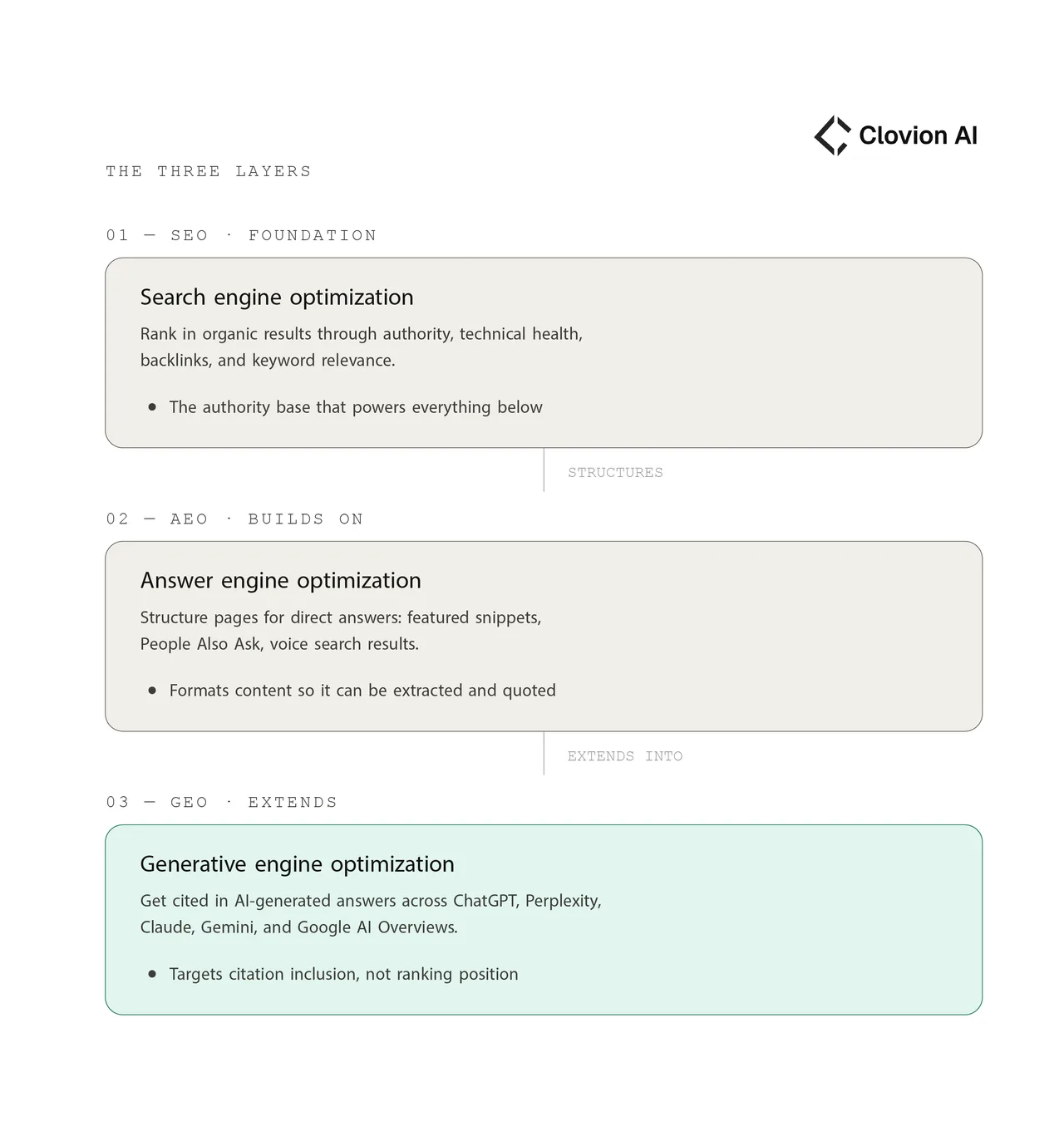
Think of it in three layers:
SEO builds your authority foundation through rankings, technical health, and backlinks.
AEO structures your pages for direct answers like featured snippets and People Also Ask boxes.
GEO extends your presence into AI-generated responses across ChatGPT, Claude, Gemini, Perplexity, and Google AI Overviews.
Each layer reinforces the others. You don't pick one. You stack them.
How Should You Adapt Your Strategy Right Now?
AI-focused SEO is becoming a bigger priority for brands that want to stay visible as search behavior changes. But spending without a framework just burns the budget. Here's a practical starting sequence that works regardless of your market.
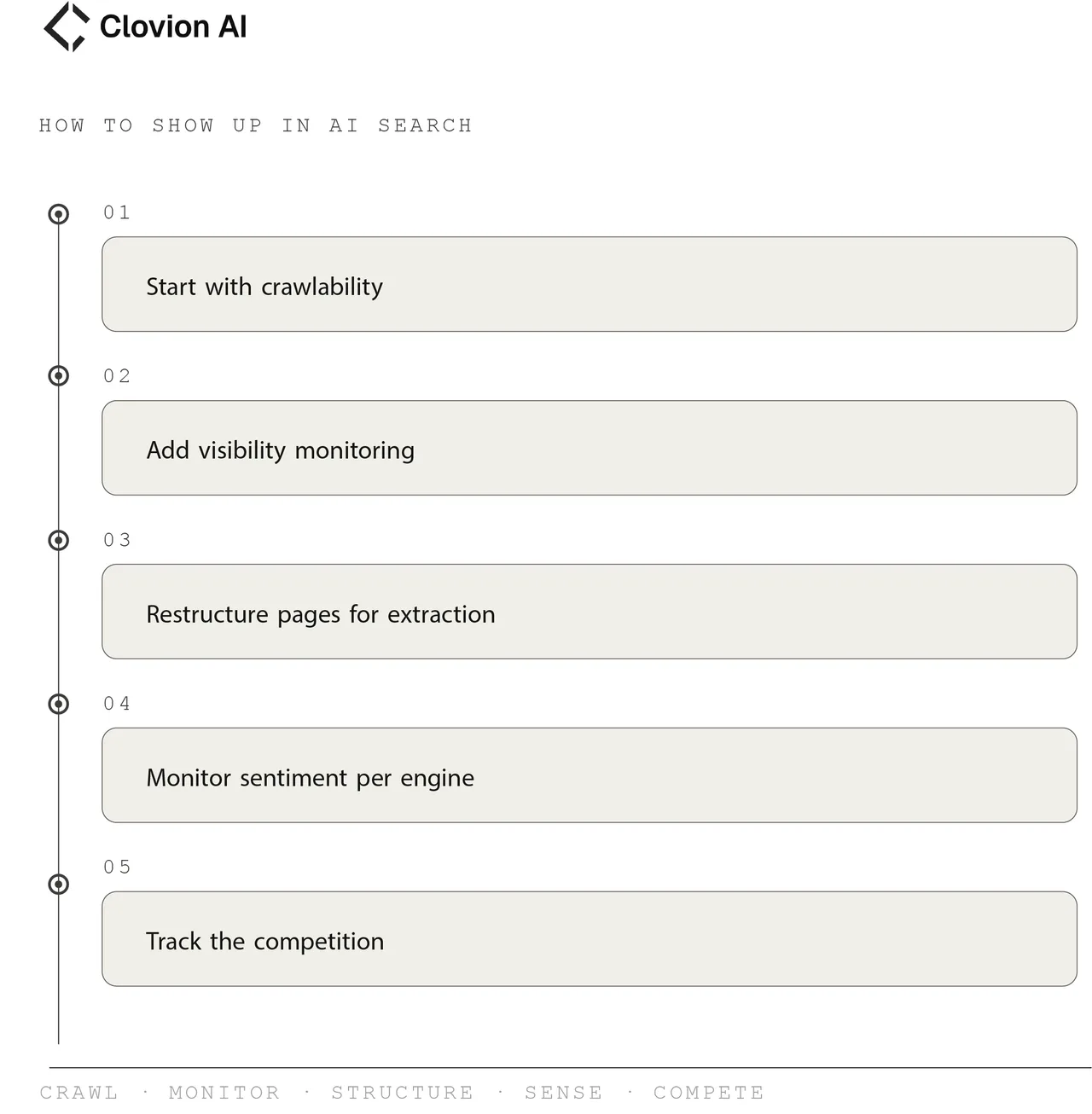
Start with crawlability.
Review your robots.txt and CDN settings. Confirm that ChatGPT-User, ClaudeBot, PerplexityBot, and Googlebot can all access your pages. Generate machine-readable files like llms.txt and llms-full.txt that map your site structure for AI systems.
Add visibility monitoring.
Track where your brand shows up (and where it doesn't) across ChatGPT, Claude, Gemini, Perplexity, Grok, and Google AI Overviews. Use brand-neutral prompts to avoid biased results.
Restructure key pages for extraction.
Reformat your highest-value content with H2 headings phrased as questions, answer-first opening paragraphs, FAQ blocks, comparison tables, and sourced data points. Give the language model a clear, quotable passage to pull from.
Monitor sentiment per engine.
Being mentioned isn't enough if the AI says something negative about your brand. What ChatGPT says may differ from what Perplexity or Gemini says. Each platform draws on different training data with different tendencies.
Track the competition.
When a rival earns a citation and you don't, the AI just recommended them to your potential customer. Most brands don't track this at all yet, which means monitoring alone puts you ahead of the majority of your competitors.
Final Thoughts
Traditional SEO isn't going anywhere. But treating it as the complete strategy is an increasingly expensive bet.
The brands pulling ahead globally are running both disciplines together. They track organic rankings and AI citations in the same dashboard. They optimize content for Google's algorithm and for the extraction patterns of ChatGPT, Perplexity, and Gemini. They measure per-engine sentiment, not just aggregate mentions.
Your customers are already asking AI tools questions about your category. The only question left is whether your brand shows up in the answer.
Frequently Asked Questions
Is traditional SEO dead in 2026?
No, but it's not enough on its own. SEO still matters for commercial-intent keywords and site authority, but brands need GEO alongside it to stay visible where AI-generated answers are replacing organic clicks. If you depend only on SEO then you’re losing the game without even fighting.
What is Generative Engine Optimization (GEO)?
GEO is the practice of structuring content so that AI platforms like ChatGPT, Perplexity, Claude, Gemini, and Google AI Overviews cite or recommend your brand in their generated responses. Unlike traditional SEO, which targets ranking position, GEO targets citation inclusion. Tactics like adding sourced statistics, structuring extractable answer blocks, and building FAQ sections all improve your chances of being cited.
How do I track my brand's visibility in AI search results?
Use a monitoring platform that covers multiple AI engines at once. Look for tools that use brand-neutral prompts (so your results reflect what real users see), provide per-engine sentiment breakdowns, and benchmark you against competitors for the full share-of-voice picture. Most brands don't track this yet, so starting now gives you a real head start.
Does ranking #1 on Google still matter?
For purchase-intent searches, yes, most marketers globally still rate it as important. For informational queries, the #1 spot has lost most of its click-through value since AI Overviews started appearing. The higher-impact move now is earning a citation inside the AI answer itself, which actually boosts your clicks rather than replacing them.
What's the difference between SEO, AEO, and GEO?
They're layered disciplines. SEO optimizes for ranking in search engine results. AEO (Answer Engine Optimization) targets direct-answer placements like featured snippets and People Also Ask. GEO targets citation in AI-generated responses across ChatGPT, Perplexity, Claude, and similar platforms. They reinforce each other: SEO builds authority, AEO structures content for extraction, and GEO extends presence into conversational AI.
Reading is fine. Measuring is better.
Free score in 60 seconds. Enter your domain and see how the major AI engines mention you, which competitors appear, and where to improve.