How to Track Brand Mentions in AI Search (ChatGPT, Perplexity, Gemini)
ChatGPT, Perplexity, and Gemini are building answers about your brand every day. Most companies have no way to see what they're saying. This guide covers how to track AI brand mentions across platforms, which metrics actually matter, and what to do with the data.
Right now, someone is asking ChatGPT whether your product is worth evaluating. Someone else is asking Perplexity to compare you against three competitors. Another buyer is asking Gemini what your brand actually does.
In all three conversations, the AI is building an answer about your brand. You have no idea what it's saying.
That's the core problem. Google gives you Search Console. Social platforms give you reach metrics. Review sites give you ratings. But ChatGPT, Perplexity, and Gemini give you nothing. No impressions data. No analytics dashboard. No built-in way to see what they say about you.
This post explains what AI brand monitoring actually involves, why it's different from anything your team has done before, how each platform works differently, and how to set up a practical tracking system that gives you real data.
Key Takeaways:
AI brand monitoring is a different discipline from traditional media monitoring. You're probing AI engines with defined queries, not scanning published content.
Each platform behaves differently. A brand can dominate ChatGPT responses and be completely absent from Perplexity, because each draws on different sources and ranking signals.
The useful metric is visibility rate (what percentage of relevant prompts mention your brand), not rank position. Ranking in a single AI response is essentially random.
Start with a query bank of 30 to 50 prompts your customers actually ask, then run them across platforms on a regular cadence.
45% of marketing leaders say they can't accurately measure their brand visibility in AI answers, and only 9% have the tools to track all relevant metrics across platforms (Semrush, 2026). It's not that people aren't paying attention. It's that the measurement infrastructure doesn't exist in traditional tools.
What's the Difference Between a Mention and a Citation?
This distinction matters more than it might seem.
A mention is when the AI names your brand in the response text. Something like "tools like Ahrefs and Semrush are commonly used for this." Your brand appeared in the answer. The user saw it. That builds awareness and shapes perception.
A citation is when the AI links to a specific page on your website as a source. Your URL appears in the footnotes or reference panel. That drives actual traffic.
Mentions build awareness. Citations drive clicks. You need to track both, because they measure different things. A brand with high mentions but low citations is being talked about without being used as a source. A brand with high citations but low mentions is trusted as a reference but not top-of-mind in the conversation.
On Gemini specifically, the overlap between mentioned brands and cited domains can be as low as 30% (Semrush, 2026). That means being mentioned and being cited are almost separate competitions. You need to win both.
How Does Each Platform Work Differently?
This is the part most guides skip. Each AI engine pulls from different sources, cites differently, and rewards different content signals. Treating them as interchangeable will give you misleading data.
ChatGPT
ChatGPT has the largest user base and processes billions of prompts daily. When it can't answer from training data alone, it uses a retrieval system to search the web live, breaking your query into multiple sub-queries and synthesizing results from across them.
Here's what makes ChatGPT tracking tricky. Only 12% of pages that rank #1 on Google actually get cited by ChatGPT (Ahrefs, 2026). That's because ChatGPT uses Bing's index for its web retrieval, not Google's. A page dominating Google might be invisible to ChatGPT's crawler. If you're not in Bing's index, you're not in ChatGPT's retrieval pool.
ChatGPT also favors listicle-format pages for citations and tends to absorb more content from each source it cites, meaning a single ChatGPT citation carries higher influence per mention than on other platforms.
Perplexity
Perplexity is structurally different from every other platform. It crawls the web in real time using its own crawler (PerplexityBot) and always includes clickable inline citations. Every response references four to eight sources, and each one links back to the original page.
That makes Perplexity the easiest platform to monitor through traditional analytics, since every citation generates a trackable click. It also weighs content freshness much more heavily than Google does. Newer, recently updated content gets cited more often, even if it has fewer backlinks.
Gemini
Gemini powers both Google's AI Overviews inside Search and Google's standalone AI assistant. The AI Overview version pulls from Google's own index, so your existing SEO work carries over more directly here than on any other platform.
But the standalone Gemini experience is harder to track. There's no built-in reporting, no referral attribution, and no public API for monitoring. And as noted, the gap between being mentioned and being cited as a source is wider on Gemini than anywhere else.
Why This Matters for Tracking
A brand can show up in 60% of ChatGPT responses for a category and only 15% of Perplexity responses for the same queries, because the two platforms use entirely different data sources and ranking signals. If you only monitor one platform, you're getting a partial, potentially misleading picture.
What Should You Actually Track?
Traditional SEO taught everyone to obsess over rank position. In AI search, that metric is almost meaningless. SparkToro demonstrated that ranking position within an AI response is essentially random, varying from query to query and session to session.
The metrics that actually matter are different.
Visibility rate. What percentage of relevant prompts mention your brand? A 40% visibility rate across 200 prompt runs is meaningful, repeatable data. Being "ranked #2" in a single ChatGPT response tells you nothing.
Share of voice. How does your visibility rate compare to your direct competitors? Your absolute number matters less than your relative position. If you appear in 30% of responses and your top competitor appears in 65%, the gap tells you more than your number alone.
Mention vs. citation split. Are you being named in the answer text, cited as a source with a link, or both? Each tells a different story about how the AI perceives your authority.
Sentiment per engine. What is the AI actually saying about you? Being mentioned negatively is worse than not being mentioned at all. And what ChatGPT says may differ sharply from what Perplexity or Gemini says.
Competitor displacement. When a competitor gets cited and you don't for the same query, that's a direct recommendation to your potential customer. Track these gaps by query.
In some industries this competitive dynamic is extremely concentrated. In News and Media, the top 3 brands capture 82.9% of total AI visibility. In Finance, that figure drops to 41.4% (Semrush, 2026). Your industry determines how much room there is to compete.
How Do You Set Up a Practical Monitoring System?
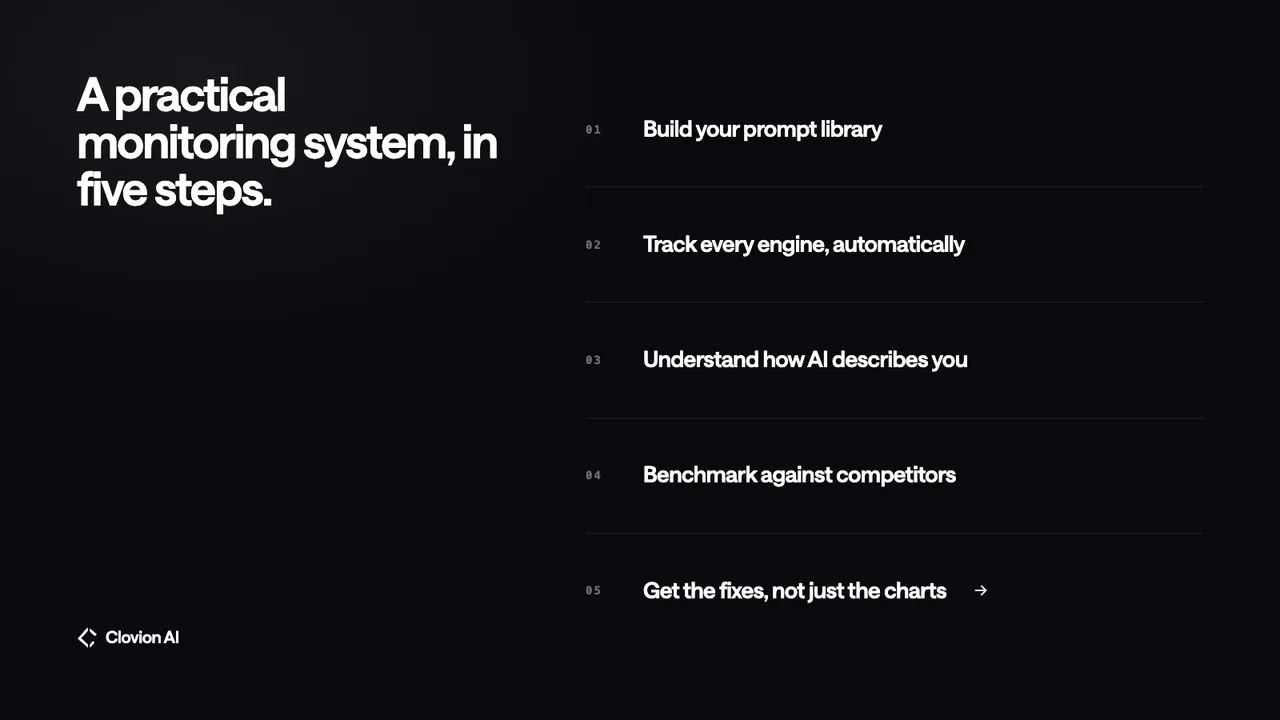
You can start manually with a spreadsheet. But if you want to move past the initial testing phase, here's how Clovion AI turns the process into a repeatable workflow.
Step 1: Build your prompt library
Write down the 30 to 50 questions your customers ask most often. Check your Google Search Console for the queries people already use to find you. Ask your sales team what prospects bring up on calls. Look at what your competitors rank for.
Your list should include things like "best [your category] for [specific use case]," "[your brand] vs [competitor name]," and "what does [your brand] do."
This list is your foundation. Everything else builds on it.
Step 2: Track visibility across every engine, automatically
Run your prompt list across ChatGPT, Perplexity, Gemini, Claude, Grok, and Google AI Overviews. For each one, record four things: did your brand get mentioned, did the AI link to your website, which competitors showed up, and what did the AI actually say about you.
The right tool will turn all of this into a single score you can watch over time, so you're not drowning in spreadsheets. You should also be able to look at each engine individually to spot where you're doing well and where you're missing entirely.
One important thing: track mentions and citations separately. Being named in the answer and being linked as a source are two different things. They tell you different stories and need different fixes.
Step 3: Understand how AI describes you
Knowing that you showed up is only half the picture. You also need to know what the AI is saying about you.
Is ChatGPT positive while Perplexity sounds lukewarm? Is Gemini calling you "enterprise-focused" while a competitor gets described as "easy to set up"? These patterns matter. They shape how potential buyers think about you before they ever visit your website.
Step 4: Benchmark against competitors
Your own numbers don't mean much on their own. You need to see how you compare.
Run the same prompts for three to five direct competitors. Compare who shows up more often, on which engines, and for which types of questions.
When a competitor starts getting mentioned and you don't, you want to know exactly which prompts changed and what content the AI is pulling from. That turns a vague feeling of "we're falling behind" into a clear list of pages to fix.
Step 5: Get the fixes, not just the charts
This is where most monitoring tools stop. They show you the data and leave it up to you to figure out what to do next.
The better platforms go further. They take everything from the steps above and turn it into a prioritized list of fixes: which pages to restructure, which crawlers to unblock, which content gaps to close, and how much impact each fix is likely to have. That way your team isn't staring at a dashboard wondering where to start.
The goal is a closed loop. Track where you stand. Understand why. Fix the gaps. Measure the result.
What Can You Do Once You Have the Data?
Monitoring is only useful if it connects to action. Here's what the data should tell you.
If you're mentioned but not cited, the AI knows your brand exists but doesn't trust your content enough to link to it as a source. The fix is structural: add sourced claims, comparison tables, FAQ blocks, and clear answer-first formatting to your key pages so the AI has something worth citing.
If you're cited on one platform but not another, look at the differences. If you're missing from ChatGPT, check your Bing Webmaster Tools setup and submit your sitemap. If you're missing from Perplexity, focus on content freshness, since Perplexity heavily favors recently updated pages.
If a competitor is being cited and you're not, study what content the AI is pulling from. Often it's a specific page with better structure, clearer data, or more recent updates. The gap is usually fixable with targeted content improvements.
If the AI is saying something inaccurate about your brand, that's a content gap, not an AI problem. The model is drawing from whatever sources it can find. Publish clear, authoritative content that directly addresses the inaccuracy, and the AI will eventually pick it up.
Final Thoughts
AI brand monitoring is becoming a new part of search visibility. Most teams still do not have a clear way to measure this. That is the opportunity.
Start with a focused prompt library. Track the same questions across the AI engines your buyers use. Look at mentions, citations, competitors, sentiment, and accuracy. Then use the gaps to improve your content, positioning, and crawlability.
You can do the first version manually.
But if AI search is becoming an important discovery channel for your brand, manual tracking will not be enough for long.
Clovion AI helps teams turn AI brand monitoring into a repeatable workflow: track where you show up, understand how AI describes you, see where competitors are winning, get the fixes that improve visibility over time, and monitor the implementations in one platform.
Because in AI search, the real risk is not just being absent.
It is not knowing what AI is saying about you in the first place.
Frequently Asked Questions
Reading is fine. Measuring is better.
Free score in 60 seconds. Enter your domain and see how the major AI engines mention you, which competitors appear, and where to improve.